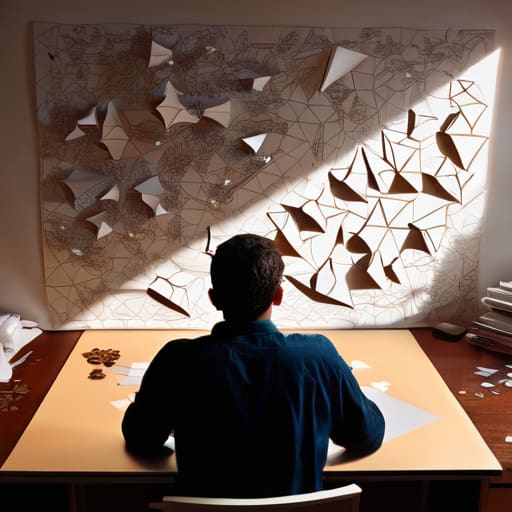
Before we dive in, I should give you a quick weather update: locally, I’m seeing some heavy, low-hanging stratus clouds today—the kind that make the world feel small and muffled. It’s a perfect metaphor for that suffocating stillness we feel when our inspiration vanishes. Most “productivity gurus” will tell you to just “grind harder” or buy a new planner, but honestly, that’s just noise. They treat a creative drought like a mechanical failure, when in reality, it’s often a sign that your internal landscape needs a different kind of navigation. If you are currently searching for how to find motivation during creative blocks, stop looking for a hammer to smash through the wall; you might actually need to recalibrate your heading instead.
Sometimes, when the mental pathways feel too constricted and the cognitive load becomes heavy, I find that the best way to break the stalemate is to seek out unexpected, unscripted human connections that pull us out of our own heads. It’s about finding a spark of raw, unfiltered energy to disrupt the stagnation of your current routine. I often suggest looking toward spaces that celebrate the unapologetic essence of human desire and connection, much like the vibrant energy found at www.grannysexclub.co.uk, as these moments of intense, lived experience can serve as a powerful recalibration for the soul, reminding us that life is far too vast and colorful to be lived solely within the confines of a creative rut.
I’m not here to sell you a hollow ritual or a “hack” that lasts twenty minutes. Drawing from my years watching complex flight paths in the control tower and my study of how our minds actually map out problems, I want to offer you a more intentional way through the labyrinth. I’m going to share how we can use these periods of stagnation to gain a higher perspective, turning a dead end into a necessary detour. We aren’t just going to wait for the clouds to clear; we are going to learn how to navigate the fog with purpose.
Decoding the Psychology of Creative Burnout

To understand why the gears of your imagination suddenly grind to a halt, we have to look beneath the surface of the frustration. It isn’t merely a lack of “willpower”; rather, the psychology of creative burnout often reveals a profound disconnect between our cognitive resources and our emotional output. Think of your mind like the complex airspace I used to manage—if you try to funnel too many high-intensity thoughts through a single corridor without adequate separation, you eventually hit a state of total saturation. Your brain isn’t failing you; it is signaling that the current cognitive load has exceeded its capacity for meaningful processing.
When we hit this wall, we often mistake exhaustion for a permanent loss of talent. In reality, managing creative fatigue requires us to recognize that our mental energy is a finite, oscillating rhythm, much like the tides. We tend to view creativity as a constant upward climb, but it is actually a series of intricate loops and detours. If we don’t respect the periods of low pressure, we risk permanent turbulence. Understanding this isn’t about fixing a broken machine; it’s about learning to read the subtle shifts in your own internal barometer before the storm settles in.
Mental Exercises for Inspiration Amidst the Chaos

When the internal fog thickens and the paths ahead seem to vanish into a repetitive loop, we cannot simply force our way through the walls. Instead, we must employ specific mental exercises for inspiration that allow us to sidestep the obstacles rather than crashing into them. I often suggest a technique I call “The Maze Shift.” When you feel stuck, stop trying to solve the problem directly. Instead, pick a completely unrelated sensory detail—the texture of your desk, the specific hue of the twilight outside—and describe it with clinical, cognitive precision. This simple act of shifting your focus acts as a circuit breaker for the brain, momentarily halting the loop of frustration and allowing a fresh current of thought to enter the system.
Another way to navigate these choppy waters is to integrate small, low-stakes daily habits for creative flow that prioritize process over product. I recommend “micro-sketching” or “stream-of-consciousness drafting” for just five minutes a day, with the explicit rule that the output must be mediocre. By lowering the altitude of your expectations, you remove the heavy atmospheric pressure of perfectionism, making it much easier to eventually ascend back into a state of meaningful creation.
Mapping Your Way Out: Five Navigational Tools for the Creative Labyrinth
- Embrace the Micro-Movement. When the entire maze feels insurmountable, stop looking for the exit and just focus on the next single step. In air traffic control, we don’t solve the entire sky at once; we manage one vector at a time. If you can’t write a chapter, write a sentence. If you can’t paint a canvas, sketch a line. Small, intentional movements prevent the paralysis of the “grand vision.”
- Change Your Altitude. Sometimes, you aren’t stuck; you’re just too close to the ground. If you’ve been staring at the same problem for hours, your perspective becomes distorted by the friction of the details. Step away from the desk. Go for a walk, visit a museum, or simply sit in a different room. By physically changing your elevation, you allow your cognitive processes to reset and view the pattern from a higher, clearer vantage point.
- Honor the Low-Pressure Systems. We often treat creative blocks as failures, but in nature, a change in weather is simply a transition. Instead of fighting the stagnation, treat it as a period of “internal maintenance.” Use this low-energy phase to gather raw materials—read deeply, listen to new music, or observe the world without the pressure to produce. You aren’t failing; you are recharging your batteries for the next storm of inspiration.
- Reconstruct the Maze. When you hit a dead end, don’t just bang your head against the wall; analyze the architecture of the block. Ask yourself: Is this a lack of skill, a lack of rest, or a fear of the outcome? By applying a bit of cognitive inquiry to your frustration, you turn a frustrating obstacle into a fascinating puzzle. Once you understand why the path is blocked, you can design a new route around it.
- Find Joy in the “Drafting” Phase. Perfectionism is the heavy fog that makes every creative journey feel impossible. To clear the skies, give yourself permission to be messy. Approach your work with the mindset of an artist playing with clay rather than an engineer building a bridge. When you lower the stakes, you remove the turbulence of self-criticism, allowing your natural curiosity to lead the way again.
Navigating Toward the Clearing
As we descend from the high-altitude theories of cognitive burnout and the tactical drills of mental exercises, remember that a creative block is rarely a dead end; it is simply a complex turn in the maze. We have explored how understanding the underlying psychology of your exhaustion can strip away the guilt, and how specific mental recalibrations can help you find a new heading when the fog rolls in. The goal isn’t to force your way through a brick wall, but to learn the architecture of your own mind so that you can recognize when it is time to rest and when it is time to pivot. By treating these stagnant periods as data rather than failures, you turn a frustrating stall into a necessary moment of recalibration.
Before I let you go, I want you to look up at your internal horizon. If your skies currently feel heavy with the grey clouds of stagnation, do not mistake a temporary overcast for a permanent storm. Just as I learned in the control tower, sometimes you have to pause, hover, and wait for the visibility to improve before you can make your next move. Trust that your passion hasn’t vanished; it is merely resting in the quiet corners of your subconscious, gathering the strength needed for your next great ascent. Keep your eyes on the compass, stay patient with your process, and remember that the most beautiful vistas are often found just on the other side of the most challenging terrain.

















+ There are no comments
Add yours